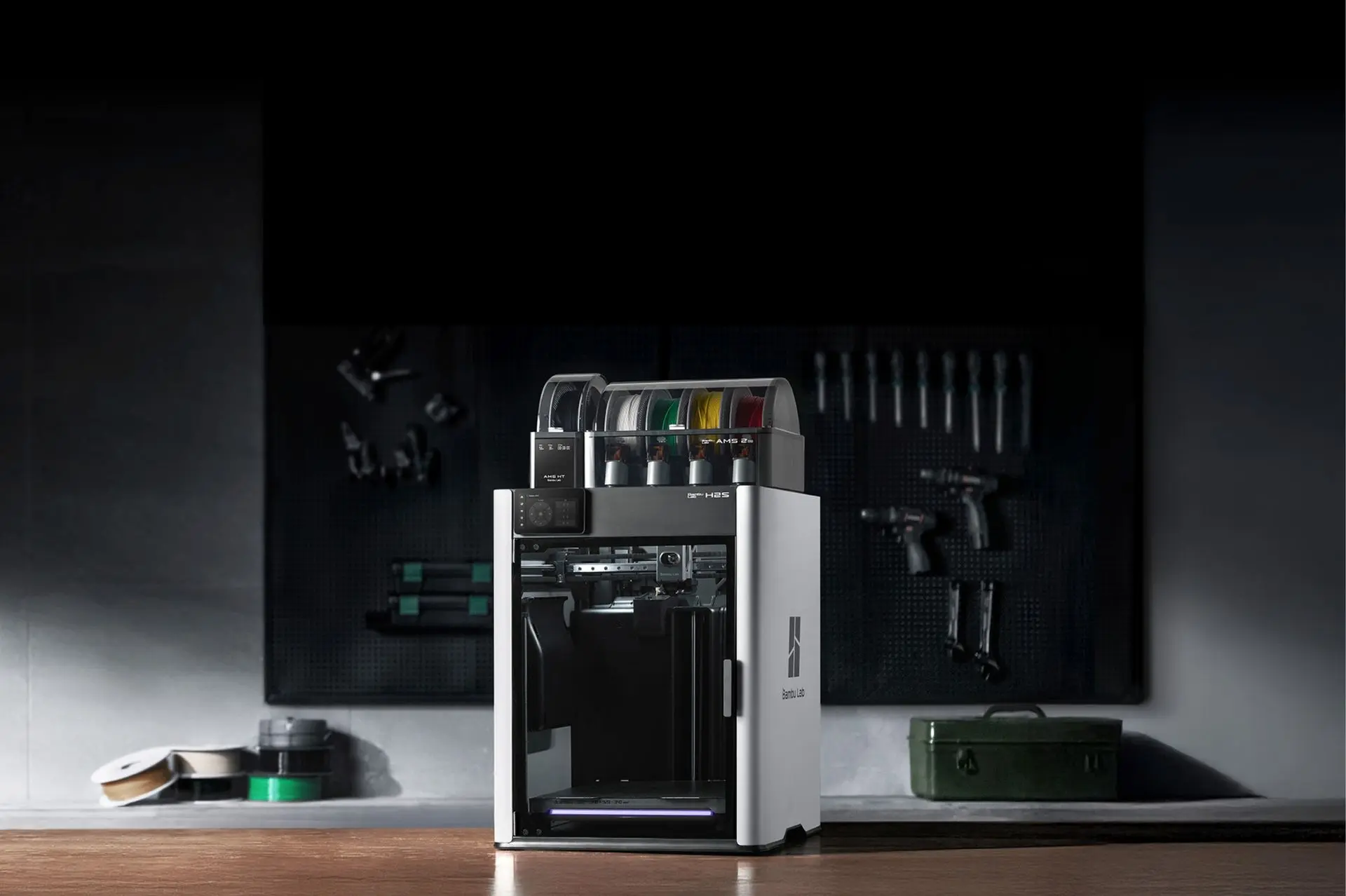
Bambu Lab P2S vs P1S: Let's Compare!
Introduction
The launch of the Bambu Lab P2S marks a new entry in the P-series printers. It has arrived as a promise to provide better and enhanced performance than the P1S with advancements from Bambu’s H-series, the P2S raises questions for existing P1S owners, 3D printing community, and those planning to invest. In this comparison, we’ll learn about upgrades, changes, performance to help you decide whether to upgrade or stick with the P1S.
Overview
Bambu Lab P1S
- Bambu Lab P1S has become a workhorse choice for professionals and specially those running print farms due to its reliability and solid performance.
-
It offers a 256 × 256 × 256 mm build volume, all-metal hotend (up to 300 °C), automatic bed leveling, and compatibility with Bambu’s AMS multi-filament system.
-
The interface is simple (non-touch, D-pad style), and its control electronics are less advanced compared to the H-series.
Bambu Lab P2S
-
The P2S is launched as a “redefined” version of the P1S, bringing in ideas and components from the H-series but at a mid range price.
-
Bambu claims a full reengineering of P2S with upgraded UI, better sensors, improved extruder, enhanced error detection, new airflow control, and more.
-
The P2S comes in two versions: a base model and a “Combo” version that includes the AMS 2 Pro for multi-filament and built-in filament drying.
Let's have a clear look:
| Feature / Spec |
Bambu Lab P1S |
Bambu Lab P2S |
Notes / Advantages |
| Build Volume |
256 × 256 × 256 mm |
No change – same compact build size. |
| Hotend & Nozzle |
All-metal hotend (up to 300 °C), standard 0.4 mm |
Up to 300 °C, supports 0.2 / 0.6 / 0.8 mm nozzles |
Same high-temp capability, more nozzle options. |
| Print Speed / Acceleration |
Up to 500 mm/s, 20,000 mm/s² acceleration |
Similar top speed but improved stability |
Better consistency at high flow rates. |
| Extruder System |
Standard direct-drive geared extruder |
New PMSM servo “DynaSense” extruder |
70% more extrusion force & clog detection. |
| Flow Calibration |
Basic firmware control |
Auto Flow Dynamics Calibration (eddy sensor) |
Real-time flow tuning for smoother prints. |
| User Interface |
Non-touch screen, D-pad navigation |
5″ full-color touchscreen (H-series UI) |
Easier control and monitoring. |
| Camera |
Basic monitoring camera |
1080p HD camera with better lighting |
Clearer timelapse and failure detection. |
| AI Error Detection |
Not available |
Yes — detects spaghetti, blobs, etc. |
Fewer failed prints, more reliability. |
| Cooling / Airflow |
Standard airflow design |
Adaptive Airflow Cooling system |
Improved temperature consistency. |
| Filament System |
Supports AMS (older version) |
AMS 2 Pro with active filament drying |
Better for multi-material and humid environments. |
| Dimensions |
389 × 389 × 458 mm / 12.95 kg |
Slightly refined chassis, similar footprint |
Fits most existing setups. |
| Price (at launch) |
Approx. $699 (AMS Combo) |
$549 (Standard) / $799 (Combo w/ AMS 2 Pro) |
Reasonable upgrade cost for added features. |
| Feature / Spec |
Bambu Lab P1S |
Bambu Lab P2S |
Notes / Advantages |
| Build Volume |
256 × 256 × 256 mm |
No change – same compact build size. |
| Hotend & Nozzle |
All-metal hotend (up to 300 °C), standard 0.4 mm |
Up to 300 °C, supports 0.2 / 0.6 / 0.8 mm nozzles |
Same high-temp capability, more nozzle options. |
| Print Speed / Acceleration |
Up to 500 mm/s, 20,000 mm/s² acceleration |
Similar top speed but improved stability |
Better consistency at high flow rates. |
| Extruder System |
Standard direct-drive geared extruder |
New PMSM servo “DynaSense” extruder |
70% more extrusion force & clog detection. |
| Flow Calibration |
Basic firmware control |
Auto Flow Dynamics Calibration (eddy sensor) |
Real-time flow tuning for smoother prints. |
| User Interface |
Non-touch screen, D-pad navigation |
5″ full-color touchscreen (H-series UI) |
Easier control and monitoring. |
| Camera |
Basic monitoring camera |
1080p HD camera with better lighting |
Clearer timelapse and failure detection. |
| AI Error Detection |
Not available |
Yes — detects spaghetti, blobs, etc. |
Fewer failed prints, more reliability. |
| Cooling / Airflow |
Standard airflow design |
Adaptive Airflow Cooling system |
Improved temperature consistency. |
| Filament System |
Supports AMS (older version) |
AMS 2 Pro with active filament drying |
Better for multi-material and humid environments. |
| Dimensions |
389 × 389 × 458 mm / 12.95 kg |
Slightly refined chassis, similar footprint |
Fits most existing setups. |
| Price (at launch) |
Approx. $699 (AMS Combo) |
$549 (Standard) / $799 (Combo w/ AMS 2 Pro) |
Reasonable upgrade cost for added features. |
The Bambu Lab P2S is clearly a refined and updated version of the P1S. While both share the same reliable core and print speed, the P2S has smart extrusion control, real time flow calibration, AI failure detection, improved cooling, and a modern touchscreen interface features that make everyday printing easy and dependable.
If you’re a new buyer, the P2S is the better long term choice, specially with the upgraded AMS 2 Pro and integrated filament drying.
However, if you already own a P1S and your prints are consistent, you may not need to upgrade immediately until you want smart automation and quality improvements.